
By Fiona Zhang
Oil prices tend to dominate the conversation around energy investing. But for refiners such as Phillips 66 (PSX) and Valero (VLO), crude prices are only part of the equation.
What matters just as much is the value created after crude reaches the refinery.
That distinction has become especially important in recent months, as tight global fuel supplies, geopolitical disruptions and strong demand for refined products have pushed refining margins sharply higher.
For investors, understanding that dynamic can provide a clearer picture of why certain energy companies may perform very differently even when they are exposed to the same commodity market.
What Is the Crack Spread?
It’s all about the spread.
A refiner buys crude, runs it through a refinery, and sells the resulting gasoline, diesel, jet fuel and other products. What matters is not simply whether crude oil goes up or down. It is whether the products coming out of the refinery are becoming more valuable faster than the crude going in.
That difference is what the industry calls the “crack spread.”
And lately, that spread has been doing a lot of the heavy lifting.
Geopolitical disruptions involving Iran and Russia have taken refining capacity and fuel supplies offline at a time when the global system was already operating with limited spare capacity. Diesel has been particularly tight. U.S. diesel inventories are running well below normal seasonal levels, while global diesel prices have climbed sharply. Reuters reported that refineries worldwide were already operating at or near capacity, while U.S. inventories remained well below normal seasonal levels. Reuters
For refiners, that is a favorable combination.
If you are Phillips 66 or Valero, you do not necessarily need oil prices to keep climbing. You need the value of the finished products to remain high relative to the cost of your crude.
The latest earnings results showed exactly what that can do.
Phillips 66 reported $3.8 billion of adjusted earnings in the second quarter, compared with just $200 million in the first quarter. Its realized refining margin jumped to $24.08 per barrel from $10.11, while refinery utilization reached 96%. Management specifically attributed the improvement in refining earnings to higher market crack spreads.
Valero saw a similar jump. Refining operating income reached $4.5 billion in the second quarter, versus $1.3 billion a year earlier. Its refining margin increased to $23.62 per barrel from $12.35, while Gulf Coast margins more than doubled to $24.42 per barrel.
That is a significant change in the economics of the business.
Why Refined Products Are So Tight
The world does not have an unlimited supply of spare refineries sitting around waiting to turn on.
When a refinery goes offline, or when a major exporter cuts shipments, someone else has to make up the difference.
Right now, there is not much room to do that.
Refineries are already running hard, while geopolitical disruptions have made the global flow of refined products less predictable. Russia has restricted diesel exports following attacks on its refineries, while disruptions in the Middle East have reduced fuel shipments from an already important supply region.
Global refining capacity is therefore being asked to do more at exactly the time when parts of that capacity are unavailable.
That helps explain why refining stocks have responded so strongly. This is not simply an energy rally showing up in a different corner of the market. Refiners are making substantially more money on each barrel they process.
Why Refining Margins Matter to Investors
The distinction between crude oil prices and refining margins is important because it shows how different parts of the energy sector can respond to very different economic forces.
An oil producer may benefit primarily from higher crude prices.
A refiner may benefit more from the spread between what it pays for crude and what it receives for gasoline, diesel, jet fuel and other finished products.
That means two companies exposed to the same broad energy environment may have very different earnings drivers.
For investors, that is a useful reminder that sector-level headlines often tell only part of the story. Understanding where profits are actually being generated can help provide a clearer view of both opportunity and risk.
When Strong Margins Meet Policy Risk
The same high fuel prices that are favorable for refiners are not particularly popular with everyone else.
Diesel is especially sensitive because it is used heavily in trucking, agriculture and manufacturing. Higher diesel prices eventually work their way through the economy, from transportation costs to the price of goods on store shelves.
That has naturally attracted Washington’s attention.
There has been discussion around restricting U.S. fuel exports to increase domestic supply and bring prices down. The problem is that the U.S. is also a major exporter of refined products.
For refiners, exports are not simply a side business. They are part of how the market clears the fuel that U.S. refineries produce.
So a policy designed to help consumers could also pressure the refining margins that have made Phillips 66 and Valero so profitable.
For now, the policy picture remains unsettled. Geopolitical headlines are moving quickly, and expectations around Iran, Russia, sanctions and fuel trade can change almost overnight.
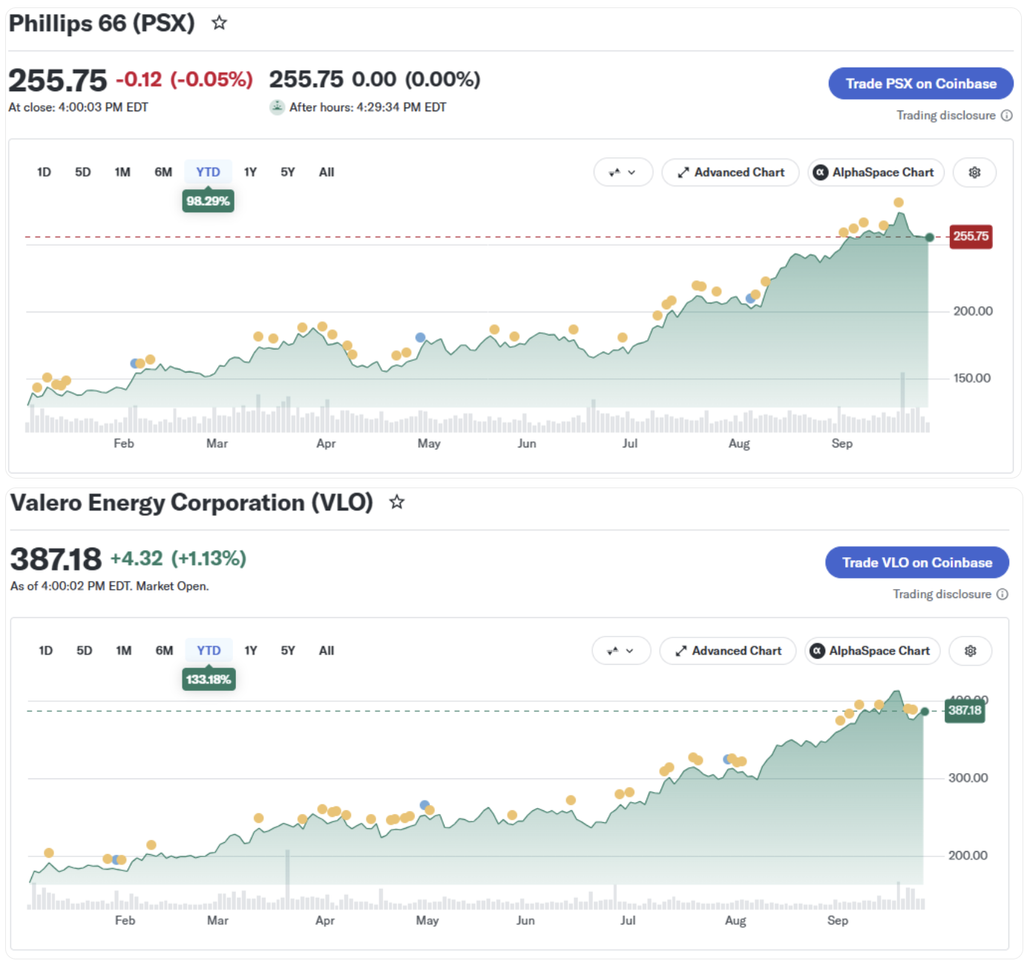
That uncertainty has begun to show up in the stocks, with both Phillips 66 and Valero pulling back from recent highs.
What Comes Next for Phillips 66 and Valero?
That does not necessarily make the refining story less interesting. In some ways, it makes the setup more nuanced.
The market is now balancing exceptionally strong current earnings against greater uncertainty about what those earnings could look like six or twelve months from now.
A headline involving Iran, Russia or U.S. fuel policy can move these stocks quickly, even though the underlying supply-and-demand picture may take much longer to change.
If those headlines meaningfully reset expectations, the resulting price moves could materially change the risk-and-reward profile investors are evaluating.
For investors, the larger lesson is that energy markets are rarely driven by a single variable.
Crude prices matter, but so do refining capacity, product inventories, geopolitics, trade policy and the economics of the supply chain itself.
Looking beyond the headline price of oil can reveal where profits are actually being created and where risks may be building beneath the surface.
Sometimes the most important part of the energy story begins after the barrel reaches the refinery.