
By Phillip Wool, Ph.D.
“Investors who focus solely on red or blue can miss out on the green.”
— Mark Hulbert, financial analyst and founder of Hulbert Ratings
With the 2026 midterm elections approaching, investors are considering what a potential shift in congressional control could mean for financial markets, economic policy, and their portfolios.
Political outcomes can meaningfully affect taxes, regulation, government spending, and the broader economy. But predicting an election result and predicting how markets will respond are two very different challenges.
Historical data offer an interesting perspective. While stocks have generally performed well following midterm elections, the relationship between politics and investment returns is far from straightforward.
What History Tells Us About Post-Midterm Stock Returns
Research examining S&P 500 Index performance following midterm elections reveals a pattern that may surprise investors.
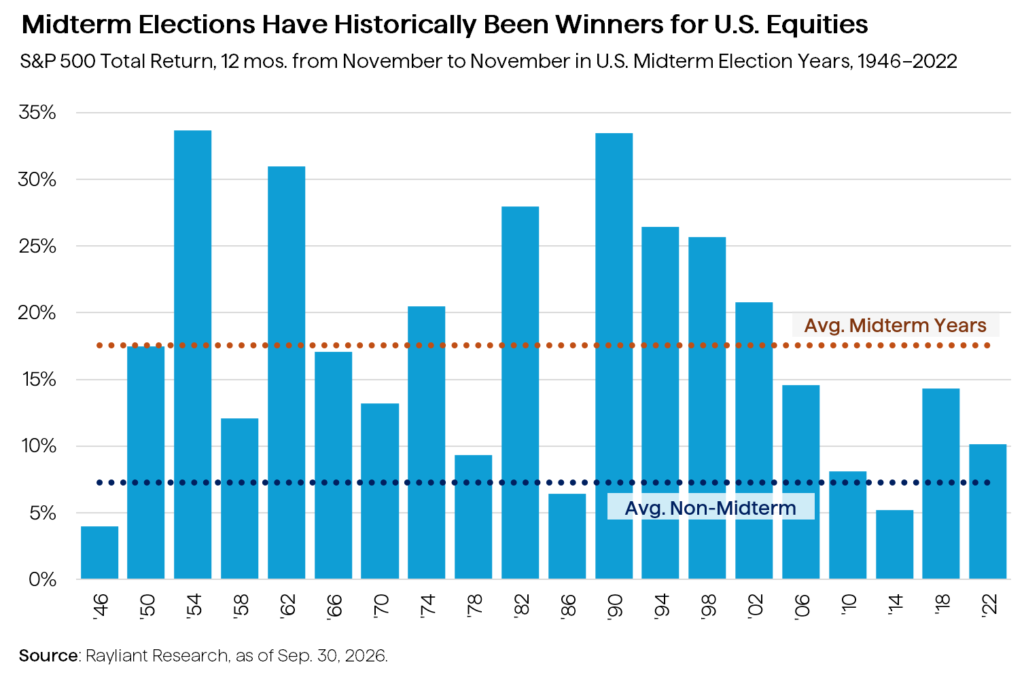
Looking at the 12-month periods beginning in November of each midterm election year, the S&P 500 generated an average return of more than 17.5% across the historical periods studied from 1946 through 2023. By comparison, the average return for the non-midterm periods examined was approximately 7.3%.
That difference is notable, but it doesn’t mean strong returns are guaranteed following an election.
Consider two historical examples:
In 1954, Democrats regained control of both chambers of Congress during Republican President Dwight Eisenhower’s first term. Over the following 12 months, the S&P 500 advanced more than 33%.
Eight years earlier, in 1946, Democrats lost control of both chambers under President Harry Truman. The S&P 500 gained approximately 4% over the subsequent year.
Both elections represented significant political changes, yet market performance differed dramatically.
Why Election Results Don’t Tell the Whole Story
One explanation for historically strong post-midterm returns is that markets respond favorably when political uncertainty begins to subside.
Once an election concludes, investors have a clearer understanding of which party will control Congress and the potential direction of future policies.
However, markets are forward-looking. Stock prices reflect investor expectations long before election results are announced.
Economic conditions also matter.
The strong returns following the 1954 midterms occurred during a significant postwar economic expansion. Conversely, the comparatively modest gains following the 1946 election unfolded against a backdrop of economic challenges associated with the transition from wartime production.
These examples illustrate why investors should be cautious about attributing market performance to election outcomes alone.
What the Midterms Could Mean for Wealth Planning
For high-net-worth and ultra-high-net-worth investors, the implications of political change often extend beyond short-term stock market performance.
Changes in congressional leadership can influence tax legislation, estate planning considerations, capital gains treatment, and regulatory policy. These potential developments may warrant attention within a comprehensive wealth management strategy.
Yet it’s important to distinguish between planning for possible policy changes and making investment decisions based on political expectations.
For example, an anticipated change in tax policy may create an opportunity to review the timing of capital gains realization, charitable contributions, or wealth transfers. Those decisions should be evaluated in the context of an investor’s broader financial circumstances rather than assumptions about which party will prevail.
Similarly, changes in regulation may affect certain industries or investment opportunities without necessarily determining the direction of the overall stock market.
Keeping Long-Term Investment Goals in Focus
Political developments can influence market sentiment, but history suggests that valuations, economic growth, corporate earnings, and broader financial conditions often play a more substantial role in determining long-term investment returns.
That distinction becomes particularly important when investors are managing significant wealth across multiple accounts, asset classes, and planning objectives.
A well-considered investment strategy should be capable of navigating changing political environments without requiring investors to correctly predict election outcomes.
Diversification, disciplined portfolio management, and thoughtful tax planning can help investors remain focused on long-term objectives even as the political landscape evolves.
The upcoming midterms will undoubtedly generate debate about winners, losers, and potential implications for financial markets. But for long-term investors, the more important question may not be which party controls Congress.
It’s whether their wealth management strategy is prepared for a range of potential outcomes.
Source and attribution: Adapted from Crunching the Numbers on Post-Midterm Stock Performance by Phillip Wool, Ph.D., Rayliant Investment Research, October 12, 2026.
Disclosure: This material is for informational purposes only and should not be considered investment advice. An investor should consult with their financial professional before making any investment decisions. The opinions contained herein are subject to change without notice and do not necessarily reflect the opinions of Rayliant Investment Research. Indices cannot be invested in directly and are unmanaged. Past performance is not indicative of future results.