

Perspectives by Phil Wool, PhD
“The combination of rapid economic growth, young populations, and a massive catch-up in technology means that the corporate champions of tomorrow are being built in these regions today.”
—Van Agtmael, economist who coined the term ‘Emerging Markets’
As students of behavioral finance, we’re always thinking about how the natural foibles of human psychology might lead to mistakes when implementing investment strategies. After all, our brains weren’t optimized to navigate financial markets, but to maximize our chances of survival in a world of dangers that predate Wall Street’s bubbles and crashes by many millennia! The premise of behavioral finance is simple: If we could better understand how portfolio managers, advisors, and their clients think, the logic goes, we could avoid such ‘unforced errors’, build more robust portfolios, and achieve much better investment outcomes. Along those lines, when it comes to asset allocation, perhaps the most impactful investment decision any advisor will make on behalf of clients, it seems that no behavioral anomaly is as pervasive as that of home bias: the tendency for investors to allocate disproportionately to their “home” market—for most reading this, that would be the United States—and forego equity opportunities abroad.
Some investors imagine that avoiding home bias requires underweighting U.S. stocks and overloading one’s portfolio with international equities. Happily, this is not the case. If an advisor invested by equity market cap, they would find that almost two-thirds of their portfolio was allocated to U.S. stocks as a passive baseline. With a little research, they would find plenty of reasonable, data-driven weighting schemes that lead to even higher allocations to U.S. equities. Even so, we’ve run into plenty of advisors who take things to the other extreme, choosing to hold only U.S. stocks and completely eschewing the broad set of investment opportunities—not to mention the simple diversification benefit—available beyond America’s borders.
How U.S. Stock Performance Reinforced Home Bias
These observations naturally raise the question of how much home bias has historically cost advisors and their clients. Ironically, much to the chagrin of economists and institutional investors, most of whom regard under-diversification as a serious portfolio blunder to be avoided at all costs, one finds that for much of the last 15 years, home bias actually worked in investors’ favor—as long as they were American, that is—with U.S. stocks meaningfully outperforming those in markets across the rest of the world. An investment in the S&P 500 Index, for instance, returned almost 14% per annum from 2010 to 2024, while the truly global MSCI All Country World Index delivered just under 10%. That performance gap naturally emboldened many investors to an even deeper distaste for stocks outside the United States. After all, shouldn’t we follow the data?
Emerging Markets Are Challenging the Home Bias Case
But of course, markets change, and the data keep coming. Along those lines, the last couple of years have brought a much different dynamic to conversations about global equity performance. Take stocks in emerging markets, for example: a particularly unloved geography among the home-bias crowd. It might surprise some readers to learn that from the beginning of 2025 through June of this year, EM shares have rallied 66.6%, more than twice the S&P 500’s 29.9% return over the same stretch. Not surprisingly, these comparisons have recently led more advisors and their clients to take a closer look at what they might be missing without an allocation to EM.
Why Emerging Markets Look Different Today
The answer, it turns out, is quite different today than it was even a few years ago. Way back in 2000, when U.S. tech stocks were hitting record highs, investors rightly thought of EM as a highly cyclical play on materials, energy, and cheap manufacturing for export to developed economies. But over the last decade, EM’s profile has changed considerably, with rapid earnings growth coming not just from those traditional exports, but increasingly from the expansion of developing countries’ domestic demand for everything from communication services and health care to fintech and clean energy technology. Because these earnings are less tied to developed markets’ business cycles, they should naturally be a more diversifying source of growth.
Asian Emerging Markets and the Global AI Investment Theme
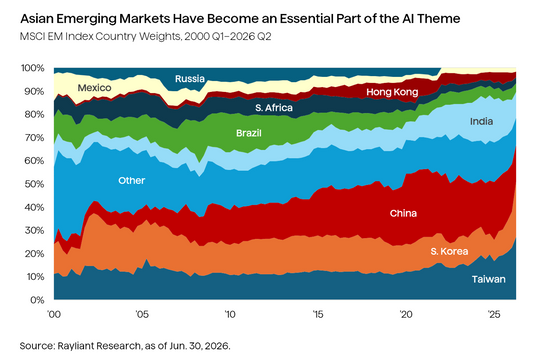
Even EM exports have taken on a different character in recent years, moving from low-quality manufacturing of low-cost goods—think t-shirts and plastic phone cases—to advanced technology at the heart of AI data centers, the likes of which companies such as TSMC, Samsung Electronics, and SK Hynix can’t seem to manufacture fast enough. Indeed, as the chart above illustrates, the current AI wave has expanded Taiwanese and Korean stocks’ footprint from less than a quarter of the EM index before the pandemic to over half today. Add in China, and East Asian benchmark weight has likewise gone from less than one-fourth of the EM index at the turn of the century to more than two-thirds of the portfolio’s weight today.
International Diversification in a Changing Global Market
The upshot of all this is that it’s actually hard to imagine constructing a truly complete exposure to the global economy—or even just the AI theme, for that matter—without venturing beyond America’s borders. The good news for investors considering an allocation to EM in search of broader access to global technology is that the MSCI EM Index is full of it, with 45% weight to IT stocks as of the end of June: even more than the S&P 500’s weight to tech of just under 38%. And whereas the S&P traded at a forward P/E of 22x at the end of June, the MSCI EM Index sold for just 13x forward earnings. Given stats like these, we wouldn’t be surprised to see more advisors putting a higher priority on diversification, setting aside home bias, and taking a more confident step into international equities.
Disclosure: This material is for informational purposes only and should not be considered investment advice. An investor should consult with their financial professional before making any investment decisions. The opinions contained herein are subject to change without notice. Index data sourced from MSCI and S&P Dow Jones Indices as of June 30, 2026. Indices are unmanaged, cannot be invested in directly, and index returns do not reflect the deduction of any fees, expenses, or taxes. Past performance is not indicative of future results.